
All case studies
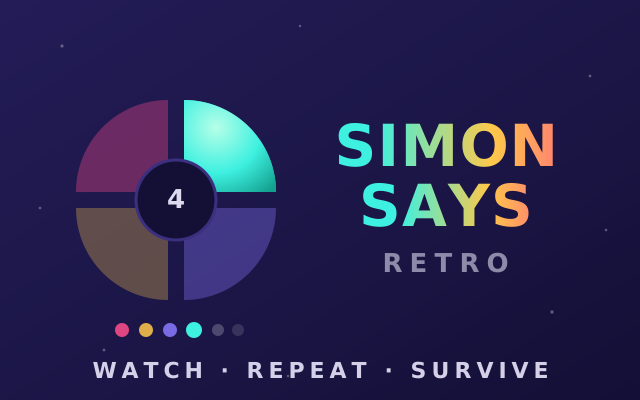
Simon Says Retro — why the sequence must never speed up
Every memory game is tempted to accelerate as rounds grow. Doing it turns a memory test into a reaction test, and players lose rounds they could have remembered.
- Client
- In-house title
- Platform
- WebGL / browser
- Engine
- Unity
- Genre
- Arcade
Unity WebGLC#Brotli compressionApache
The challenge
Simon is one of the few games where the design is already finished before you start. Four pads, a growing sequence, one mistake ends it. There is nothing to add, and almost everything you could add would make it worse. That makes it a strange thing to build: the work is entirely in execution, and every shortcut is visible.The first problem is that the game's difficulty is supposed to come from the player's memory, not from the game. The temptation in every memory game is to speed the sequence up as rounds progress, because it looks like difficulty scaling and it is trivial to implement. It is also a different game. A faster sequence tests reaction and perception; a longer sequence tests memory. Speed up the playback and a player who could have remembered fourteen steps now fails at nine because they could not see them — and they will blame the game, correctly, for changing the rules.
The second problem is feedback timing, and it is where most clones feel wrong without anyone being able to say why. When the player taps a pad, that pad has to light and sound immediately — not after the tap registers, not after a transition, immediately. Simon is a rhythm of input and confirmation, and even a short delay breaks the player's sense that the board is responding to them. In a game where each round can be twenty taps long, a few dozen milliseconds of lag per tap accumulates into a session that feels sluggish and unresponsive.
Third, and most important: the audio is not decoration. Each pad has a distinct tone, and the reason Simon works at all is that players stop memorising a list of colours and start memorising a melody. Human memory chunks a long sequence into a phrase, and the tone is what makes chunking possible. Treat the sound as an optional flourish, mute it or make the tones indistinct, and the game's effective difficulty ceiling drops by several rounds. This is the single most commonly missed point in Simon implementations.
Fourth, the sequence must replay from the beginning every round. Showing only the newly added step would be kinder and would destroy the game — the entire challenge is holding the accumulated sequence, and re-watching it from the start is how the player rehearses and consolidates it.
And fifth, one wrong pad has to end the run. A forgiving version with lives or partial credit removes the only thing creating tension at round twelve, where the player is already most of the way through a sequence they half-remember.
Our approach
Playback speed is held constant across every round. The sequence at round twenty plays at exactly the pace it did at round two — it is simply longer. That single decision is what keeps this a memory game rather than a reaction game, and it means a player's improvement is real: when they reach round fifteen, it is because they remember more, not because they got faster at seeing. The difficulty curve is supplied entirely by the player's own limits, which is why the game needs no difficulty settings at all.Each pad was given a distinct, musically separated tone rather than four variations of a beep. This is treated as core mechanics, not audio polish, because the tone is what lets the player convert a list into a phrase. A player around round seven typically stops thinking "green, red, red, blue" and starts hearing a short tune — and that chunking is the only reason sequences beyond about seven steps are reachable at all, since that is roughly where unaided short-term memory for discrete items runs out.
Input feedback is immediate and unconditional. The moment a pad is touched it lights and sounds, before any correctness check runs. Separating the acknowledgement from the judgement is what makes the board feel alive under the finger — the player always knows the game received their tap, even in the instant before it tells them the tap was wrong. Across a twenty-tap round, that responsiveness is the difference between a board that feels like an instrument and one that feels like a form.
The full sequence replays from the start every round, with a clear pause between the game's demonstration and the player's turn. The pause matters more than it looks: without a visible handover, players start tapping while the game is still showing, and lose a run to confusion rather than to memory. A distinct "your turn" state removes an entire category of unfair loss.
One mistake ends the run, with no lives and no partial credit. That is not harshness for its own sake — it is what makes round twelve tense. A player deep into a sequence they only half-remember is experiencing the whole point of the game, and any safety net dissolves it.
The retro presentation is deliberately restrained. Four pads, a round counter, nothing else competing for attention. In a game where the player must watch a sequence closely and then recall it, every additional animation or decoration is a distraction that directly costs rounds.
On the technical side the build ships Brotli-compressed with its own server rule declaring that encoding, identified by reading the file's magic bytes rather than assuming — several titles in this library are gzip instead, and the file extension alone does not say which. The canvas is responsive, fixed to the full stage with the game scaling its own UI, so it fills the player page at any window size without cropping or letterboxing.
The result
A Simon where the difficulty is genuinely the player's memory. Playback speed never changes, so reaching round fifteen means remembering more rather than seeing faster — and the game needs no difficulty settings, because the player supplies the curve.Four musically distinct tones, treated as mechanics rather than audio polish. They are what let a player convert a list into a phrase, which is the only way sequences past about seven steps become reachable.
Input is acknowledged before it is judged: a pad lights and sounds the instant it is touched, independent of whether the tap was correct. Over a twenty-tap round, that is what makes the board feel like an instrument rather than a form.
The full sequence replays from the start each round, with a clear handover before the player's turn — which removes losses caused by tapping over the demonstration rather than by forgetting.
One mistake ends the run. No lives, no partial credit, because the tension at round twelve is the entire product.
Loads with native Brotli decompression and fills the stage at any window size, on desktop and mobile.
Playable on this site right now, with no download and no account.
More case studies
NP
 Puzzle
Nonogram Picross — teaching elimination without a tutorial
The technique that solves a nonogram is crossing squares out, not filling them in. Beginners almost never do it, so the controls had to teach it.
Read the case study →
WS
 Puzzle
Wander Star — a chain you can predict before you fire it
One tap sets off a chain that turns at every arrow and splits at some. The whole game is the few seconds before the tap, which only works if the…
Read the case study →
FC
 Arcade
Flappy Cyber Copter — the gap you could not possibly reach
The flappy format earned its bad name honestly: most clones place gaps the player cannot get to. Bounding that is a generation constraint, and it…
Read the case study →
Puzzle
Nonogram Picross — teaching elimination without a tutorial
The technique that solves a nonogram is crossing squares out, not filling them in. Beginners almost never do it, so the controls had to teach it.
Read the case study →
WS
Puzzle
Wander Star — a chain you can predict before you fire it
One tap sets off a chain that turns at every arrow and splits at some. The whole game is the few seconds before the tap, which only works if the…
Read the case study →
FC
Arcade
Flappy Cyber Copter — the gap you could not possibly reach
The flappy format earned its bad name honestly: most clones place gaps the player cannot get to. Bounding that is a generation constraint, and it…
Read the case study →