
All case studies
Minesweeper — fixing the first click that ruined its reputation
Most people remember Minesweeper as a luck game. That memory comes from one real flaw: on the original, the opening move could kill you before the game had told you anything.
- Client
- In-house title
- Platform
- WebGL / browser
- Engine
- Unity
- Genre
- Puzzle
Unity WebGLC#gzip compressionApache
The challenge
Minesweeper has a reputation problem that is half deserved. Most people who played it on an office computer remember it as a game of luck: you click, you die, you start again. That impression comes from a real flaw in the original — and a version that reproduces the flaw faithfully also reproduces the reputation.The flaw is the first click. On a board where mines are placed before the player touches anything, the opening move is pure chance. Worse, it is chance with no information: there is no reading to be done, because nothing is revealed. A player who loses on the first click of three consecutive games has learned, correctly, that the game wasted their time. Everything good about Minesweeper happens after the board opens up, and a first-click death prevents the game from ever starting.
The second problem is subtler and is the reason many players quietly stop. Classic Minesweeper boards can reach positions where no deduction is possible — two squares remain, one holds a mine, and nothing on the board distinguishes them. The player must guess. For a game that presents itself as logic, being forced to flip a coin at the end of a careful ten-minute board is a genuine betrayal, and it is the single most common complaint about the genre.
Third is a teaching problem. The whole skill of Minesweeper is reading two adjacent numbers together. A 1 beside a 2 often forces an answer that neither number gives alone, and that pattern recognition is what separates someone who clears boards from someone who clicks hopefully. It cannot be taught with text, because a player mid-board will not read it.
Fourth, flags are usually presented as an optional convenience, which badly undersells them. A flag is how a player writes a conclusion onto the board instead of holding it in their head. Without flags being central and easy, every interruption erases the player's reasoning, and a half-finished board becomes unresumable.
And fifth, the original's visual design was built for a 1990s desktop with a mouse. Colour-coded numbers were the one genuinely great decision in it — and most modern remakes flatten them, losing the ability to read the board at a glance.
Our approach
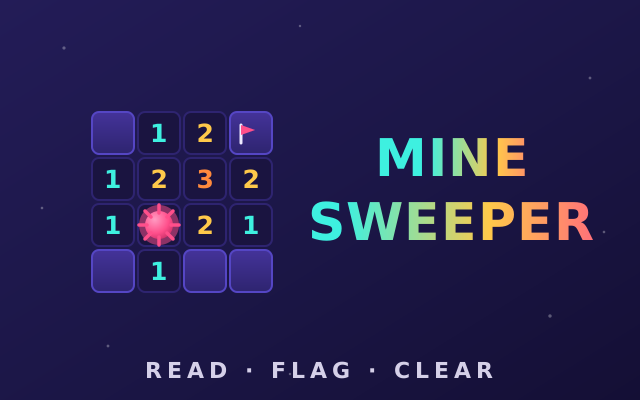
The first click is never a mine. Mines are placed after the opening click rather than before it, so the first move always reveals something and the game actually begins. This is the single change that separates a Minesweeper worth playing from one that confirms the genre's reputation — and the cost is nothing, because a board generated around the first click is just as random as one generated before it. The player simply never loses before they have had a chance to play.Numbers are colour-coded, which is the original's best idea and is kept deliberately. A 1 and a 2 are different colours, not just different glyphs, so a player scanning a crowded board reads the pattern by colour rather than by reading each digit. That speed is what makes advanced play possible: the 1-2 patterns that force answers are recognised as shapes long before they are consciously counted.
Flags are treated as the primary way the player records a conclusion, not as a convenience. Right-click to flag, and the mark stays. That externalises the deduction onto the board, which means a player can leave a half-solved grid and come back to it without having lost anything. It also makes the number-satisfaction check readable at a glance: a 2 that already touches two flags tells the player at once that everything else around it is safe.
The visual hierarchy separates three states clearly — unopened, opened with a number, and flagged — because the board is the player's entire working memory. An unopened square must read as genuinely unknown rather than as empty, so a partly-cleared board shows where the remaining work is without the player re-deriving it.
Beyond the first click, nothing about the difficulty was softened. Mine density is honest, there is no undo, and a mis-click ends the run. Removing the first-click death fixes an unfairness; making the rest forgiving would remove the tension that is the point of the game. The distinction matters: fairness and difficulty are different axes, and Minesweeper needs to be high on both.
No timer pressure is imposed on the player's thinking. The classic clock counts up as a score rather than counting down as a threat, so a player who wants to read carefully is never punished for it, while a player chasing a fast clear still has something to chase.
On the technical side this build ships gzip-compressed, identified by reading the magic bytes rather than assuming Brotli like several other titles in the library, with its own server rule declaring that encoding so the browser decompresses natively instead of falling back to the slower JavaScript path. The canvas is responsive, fixed to the full stage with the game scaling its own UI, so it fills the player page at any window size without cropping.
The result
The first click is never a mine, because mines are placed after it. That removes the single thing that gives Minesweeper its reputation as a luck game — a player can no longer lose before the board has told them anything.Colour-coded numbers are kept, because reading the board by colour instead of by digit is what makes advanced play possible. The 1-2 patterns that force an answer are recognised as shapes before they are consciously counted.
Flags are the primary way a conclusion gets written onto the board, so the grid carries the player's reasoning rather than their memory. A half-solved board can be left and resumed intact.
Three clearly separated states — unopened, numbered, flagged — so an unopened square reads as genuinely unknown and a partly-cleared board shows where the work remains.
Difficulty itself was left alone. Removing the first-click death fixes an unfairness; softening mine density or adding undo would remove the tension that is the point.
Loads with native gzip decompression and fills the stage at any window size, on desktop and mobile.
Playable on this site right now, with no download and no account.
More case studies
CN
 Board
Carrom Nights 3D — two rulesets, one board, and a screen that turns around
Everyone who downloads a carrom app already knows how it should feel. The upgrade asked a harder question: can one board serve both a newcomer and…
Read the case study →
PB
 Music
Piano Breeze — the millisecond problem nobody can describe
A rhythm game has to agree with the player about when a note was hit, on hardware that adds a different amount of audio latency to every device.
Read the case study →
ST
 Arcade
Stack Tower Builder — a miss that costs instead of kills
Most stacking games end your run on one bad tap. This one makes you live with it instead.
Read the case study →
Board
Carrom Nights 3D — two rulesets, one board, and a screen that turns around
Everyone who downloads a carrom app already knows how it should feel. The upgrade asked a harder question: can one board serve both a newcomer and…
Read the case study →
PB
Music
Piano Breeze — the millisecond problem nobody can describe
A rhythm game has to agree with the player about when a note was hit, on hardware that adds a different amount of audio latency to every device.
Read the case study →
ST
Arcade
Stack Tower Builder — a miss that costs instead of kills
Most stacking games end your run on one bad tap. This one makes you live with it instead.
Read the case study →