
All case studies
1010! Block Puzzle — losing twenty moves before you notice
No timer, no rotation, three pieces at a time. The whole design problem was making a loss traceable back to the move that caused it.
- Client
- In-house title
- Platform
- WebGL / browser
- Engine
- Unity
- Genre
- Puzzle
Unity WebGLC#Brotli compressionApache
The challenge
1010 is a deceptively exposed design. There is no timer, no enemy, no randomness the player can blame beyond the three pieces in the tray, and no rotation to bail out a bad fit. Strip all of that away and what remains is a single question asked a few hundred times in a row: where does this shape go. If the answer is ever unclear, or ever feels arbitrary, the whole game collapses — because there is nothing else happening to cover for it.The first problem is that the real mistake and the visible failure are separated by many moves. A player loses when none of their three pieces fit, but the board state that doomed them was created ten or twenty placements earlier, when they dropped a piece into open space without thinking about the hole it left behind. That gap is where most block puzzles lose people: the loss feels like bad luck with the tray rather than the consequence of a decision they made and could have made differently. If the player cannot trace the failure back, they cannot improve, and a game they cannot improve at stops being a puzzle and becomes a slot machine.
The second problem is the tray itself. Giving three pieces at once and only refilling when all three are placed is the rule that makes the game strategic rather than reactive, because it forces the player to plan a set rather than react to a single shape. It is also the rule that makes losses feel unfair if the board is not readable, since the player has to hold three different shapes in mind and test each against a grid that is becoming increasingly fragmented.
Third, no rotation is a real constraint and not a simplification. In most block games rotation is the escape hatch — a shape that does not fit can be turned until it does. Removing it means the shape the player is handed is the shape they must find room for, which doubles the weight of every placement, and makes a badly-shaped gap permanent rather than merely inconvenient.
Fourth, this is a browser build, which removes any cushion. There is no install step and therefore no sunk cost: a visitor who finds the first thirty seconds confusing simply closes the tab. The game has to teach itself through play, because nobody will sit through a tutorial for a puzzle they have not decided to care about yet.
And finally there is the grid-reading problem that this genre creates and rarely solves. A 10x10 board part-way through a game is a scattered field of filled and empty cells. The player needs to answer two questions at a glance — where could this piece go, and which line is nearly complete — and a grid that renders every cell with equal visual weight answers neither.
Our approach
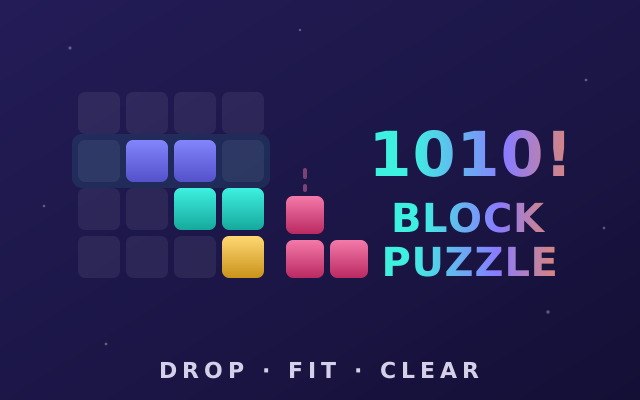
The board was built to answer the two questions the player is actually asking. Filled cells are solid, saturated colour; empty cells are a faint recessed outline rather than plain background. That difference does the heavy lifting: the eye reads the occupied shape of the grid instantly, instead of scanning cell by cell to work out what is where. A near-complete line stands out as a nearly-solid band, which is exactly the information needed to decide whether a placement is worth making.The line clear is given deliberate visual weight. It is the only reward the game has, and in a title with no score multipliers, no combos to chase and no narrative, the moment a row vanishes has to feel like it was worth planning for. Clearing a row and a column together is the implicit high note — nothing announces it, but the board opening up twice at once is its own payoff.
No rotation was kept rather than softened. It is the constraint that makes the game interesting: a player who cannot turn a piece has to find the place it already fits, which turns placement from an execution problem into a search problem. Adding rotation would have made the game easier and much less worth playing, and the temptation to add it is exactly why most clones feel samey.
The three-piece tray drives the planning loop, and the refill rule is what gives it teeth. Because new pieces only arrive once all three are placed, the player is always solving a small set rather than reacting to a stream. That creates the game's core tension: the best place for piece one is often the wrong place once you account for pieces two and three, and working that out is the whole skill.
Fairness was handled by making consequences visible rather than by softening the rule. The game never blocks a bad placement or warns against it — that would remove the decision. Instead the board is legible enough that a player who looks can see the hole they are about to create. Losses then trace back to a move the player could have seen, which is what makes the next attempt a revised plan rather than another roll.
The absence of a timer is a design position, not a missing feature. The pressure in 1010 is spatial: the board filling up is the clock. Adding a real one would push players to place quickly, and placing quickly is precisely the behaviour that loses the game — it would have fought the mechanic rather than supporting it.
Teaching happens through the early board. The first dozen placements are genuinely free because the grid is empty, which lets a player learn the controls and the clear rule without any instruction. The difficulty arrives on its own as the board fills, so the game has a natural tutorial that costs nothing and that nobody can skip past.
On the technical side the build ships Brotli-compressed with its own server rule declaring that encoding, so the browser decompresses it natively rather than falling back to the slower JavaScript path. The canvas is responsive — fixed to the full stage with the game scaling its own UI — so it fills the player page at any window size without cropping or letterboxing, on a phone or a wide monitor.
The result
A block puzzle where losing is legible. The filled-versus-empty contrast makes the shape of the board readable at a glance, so a player can see the gap they are about to create — and the loss traces back to a decision rather than to the tray.Keeping no rotation preserved the thing that makes the genre worth playing: finding where a shape already fits is a search problem, and softening it into an execution problem would have produced another clone.
The three-piece tray with batch refill is what turns each placement into a set-planning decision, because the best spot for the first piece is frequently wrong once the other two are accounted for.
No timer anywhere — the board filling is the pressure, and a clock would have punished exactly the careful play the game is built to reward.
It runs in the browser on desktop and mobile with no download and no account, fills the stage at any window size, and loads with native Brotli decompression rather than a JavaScript fallback.
Playable on this site right now.
More case studies
 Board
Chess 3D Master — giving a losing player a reason to finish
Ten shaped AI levels, bounded power-ups, and a Points Battle mode where captures score — so a player behind on material still has something to play…
Read the case study →
 Puzzle
Sudoku Puzzle — a grid you can trust, plus a second puzzle nobody expected
Rebuilt around one guarantee: every puzzle has exactly one solution, so logic is always enough — and a whole second logic game shipped alongside it.
Read the case study →
 Arcade
Color Switch Rush — a colour puzzle that works without colour
The whole game rests on telling four segments apart at speed — including for players who cannot see hue.
Read the case study →